Published isn't the finish line.
A listing can be live and still invisible. So we stopped grading listings against our own taste, and started grading them against the shelf the marketplaces actually publish.
There's a small, satisfying click of relief when a seller hits Publish. The photos are done, the words are written, the product is live. The work feels finished.
And then, for a lot of sellers, nothing happens. No traffic. No placements in the shopping results. The listing is real, it's online, you can visit it. And almost nobody else can find it. Published turns out not to mean found.
The gap between those two words is where this whole story lives.
The shelf you can't see
Every place your product can appear, whether that's Google's shopping results, a marketplace's filtered category, or a store's own search, is a shelf with rules about what's allowed on it. Those rules are real, they're written down, and they're mostly public: Google publishes a specification for how apparel data should be structured. Shopify publishes what a complete catalog entry looks like. The FTC publishes exactly how a garment's fibre content and care must be stated. Decades of storefront research say which details shoppers need before they'll trust an "Add to cart."
Big brands have people whose entire job is knowing those documents. A solo seller is competing against those teams, with the same garment, often a better one, and no playbook. The rules aren't secret. They're just two hundred pages long and written for someone else.
That asymmetry is the thing roopafy set out to erase. Not by teaching every seller to read the specs, but by knowing them so thoroughly that the seller never has to.
We grade against the shelf, not our taste
The tempting thing to build here is a "roopafy score": some confident number we invent, a green checkmark that means we approve. We deliberately didn't. A score we made up is just our opinion wearing a lab coat, and our opinion has never once ranked a product on Google.
So the check measures your listing against the external standards, the published ones, the ones that actually decide whether you show up. Not "does roopafy like this listing," but "does this listing clear the bar the marketplace itself set." When something is missing, we name the standard it's missing for, and why that shelf cares. It's the difference between a teacher who grades to their mood and one who hands you the rubric.
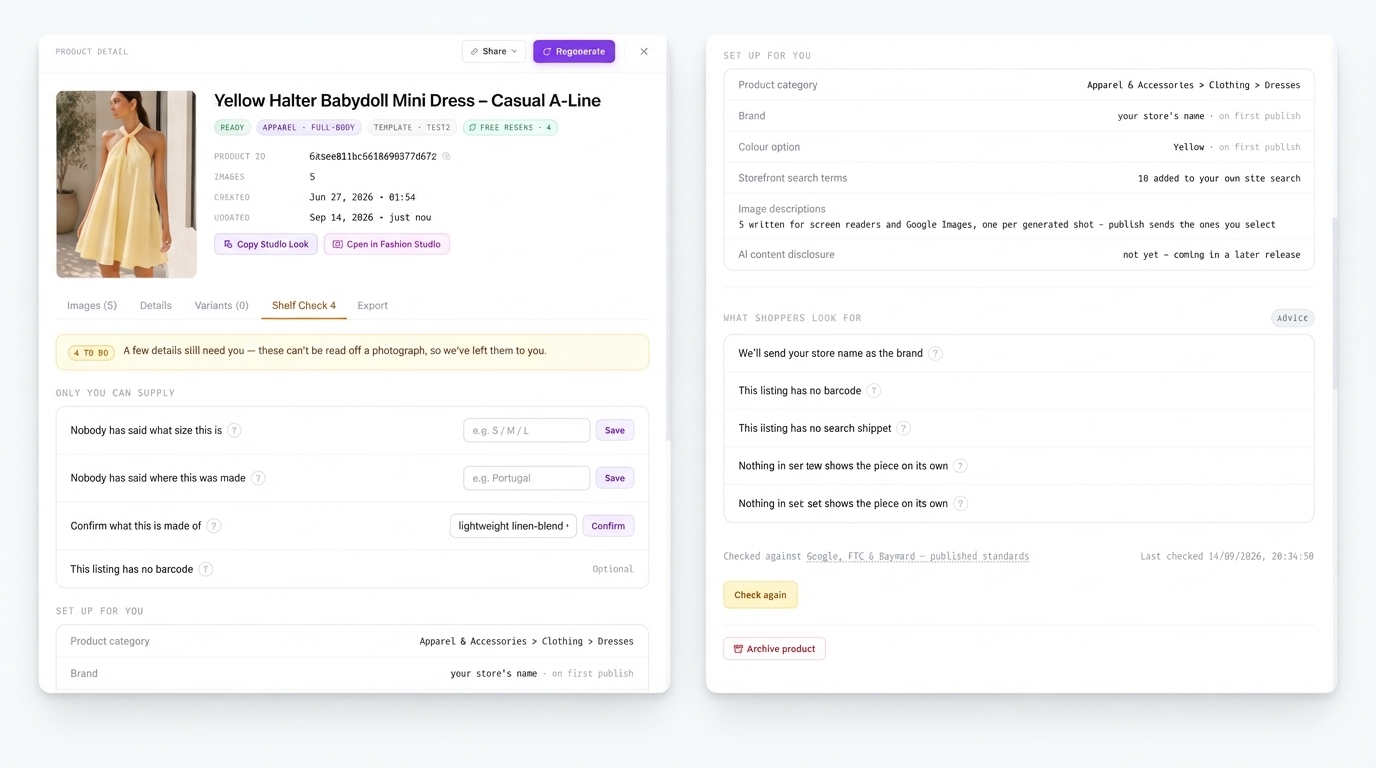
Complete before it ever leaves
Before we grade anyone else's homework, we grade our own. The listing roopafy hands you is built to be complete on the way out the door: real descriptions, honest alternative text on every image, the colour and search details a catalog needs to file you correctly. The easiest listing to fix is the one that was never broken.
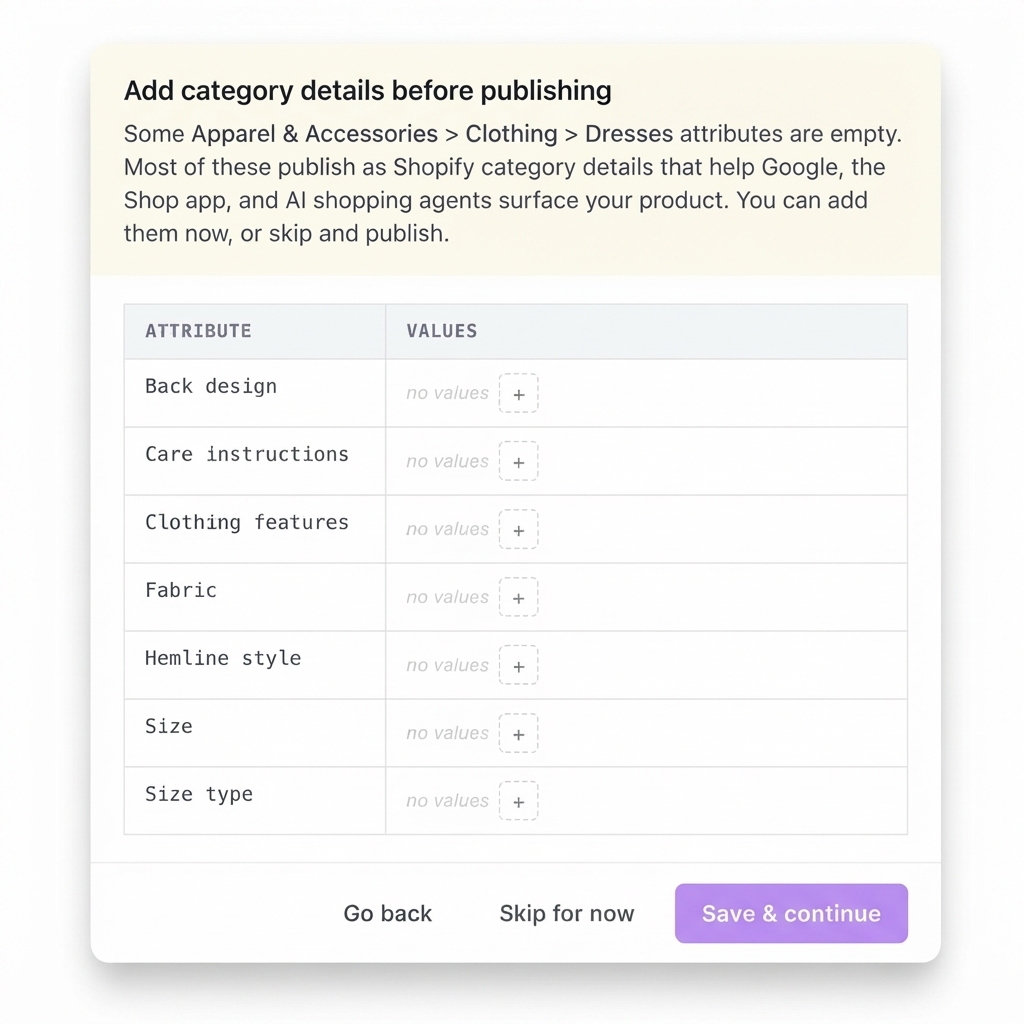
The part that quietly moves the needle most is the structured detail: the neckline, the sleeve length, the fit, the material family. These are the fields that make a catalog item properly Shopify-compatible, and Shopify-compatible is not a box-ticking exercise. It's the passport your product carries out into the wider world. Google Shopping and the other product finders pull from that same structured data, so the more complete and correct it is, the more shelf space your item earns on the surfaces where buyers are actually looking. roopafy does that compatibility work for you, effortlessly: it intelligently surfaces the empty fields before you publish, lets you fill them in a few taps, and, this matters, keeps them yours. They save back onto your product, show up in your details, and travel out as real structured data, not decoration.
And it only ever asks about your product. The check is shaped by product type, so a dress is asked about necklines and sleeve lengths, a pair of shoes about the things that matter to shoes, and neither is bothered with the other's fields. You're never handed a generic form of forty boxes to guess your way through. You're shown exactly the details relevant to what you're actually selling, and asked to add only those.
The claim we won't make for you
Here's a line we drew on purpose, and it costs us a little convenience to hold. roopafy will not publish a material, care, or size claim that our system merely guessed. If we didn't hear it from you, it doesn't go on your listing as a fact.
It would be easy to do the opposite. Our models can look at a garment and form a confident hunch: "looks like linen," or "probably machine washable." Stamping that hunch onto your product as structured truth would tick more boxes and make the listing look more complete. It would also be a claim about a real thing you're selling, made in your name, by a machine that can't feel the fabric. Fibre content and care are regulated for a reason, and the liability lands on the seller, not on the tool that filled the box.
So we hold the line: the observable stuff, we'll help with; the claims only you can stand behind, only you can make. You confirm the fabric, and then it's a fact worth publishing. Restraint, here, is the feature. A tool that quietly makes promises on your behalf isn't saving you work; it's writing cheques with your name on them.
From one listing to your whole shelf
One listing done right is the start of the idea, not the end of it. The direction we're building toward is the same standard applied wider: pointed at the products you've already published, telling you which of your existing listings are quietly underperforming the shelf and why. And, on the other end, closing the loop by confirming the marketplaces are genuinely surfacing what you sent them. Not "we published it and hoped," but "here's the proof it landed."
That's a longer road, and we'll write about those pieces as they reach you. The through-line never changes: measure against the real shelf, show the seller exactly where they stand, and never dress our own opinion up as the marketplace's rule.
We warn. We never block.
One last principle, because it's easy to get wrong. Every check roopafy runs is advice, never a gate. We'll tell you a field is empty, a claim is unconfirmed, a description is thin, and then we'll hand you the Publish button anyway. It's your product, your store, your call. A tool that holds your listing hostage until it's "perfect" has quietly decided it knows your business better than you do. It doesn't.
What we can do, what a small seller genuinely couldn't do alone, is make sure that when you choose to publish, you're choosing with the same information the big teams have. The shelf's rules, read for you. Translated into your listing. In plain language, before you commit.
Published was never really the goal. Being found was. We just moved the finish line to where it always should have been. Mason · Chief Architect, roopafy