A backdrop is not a place.
Most AI lifestyle photos put a model in front of a scene. We wanted to put her in one: a real location she sits in, leans on and walks through, and that stays the same place from the first frame to the last.
There's a kind of AI fashion photo you've probably learned to spot. The model is fine. The garment is fine. The "location" behind her is a sun-washed street, or a loft, or a beach at golden hour. And something is off. She isn't in the street. She's standing in front of a picture of one.
Her feet don't quite meet the ground. The light on her face comes from the left while the shadows on the wall say the sun is on the right. The doorway behind her is somehow shorter than she is. Generate the next frame and the street has quietly become a different street. Nobody can point at what's wrong, and everybody can feel it.
The word for that photo is backdrop. And a backdrop is not a place.
What a real location shoot buys you
Big brands shoot on location because a place does work a studio can't. It says who the garment is for and where their life happens. It gives the model something to do with her hands. It puts the clothes in motion: sitting, reaching, climbing a step, leaning on a wall. Buyers don't just see the top; they see how it moves when a person actually lives in it.
A location shoot also costs a location. A photographer, a day, travel, permits, a model who can be there in person. For a solo seller with forty items to list, that's not a decision, it's a fantasy. So they shoot on a bedroom wall, or they reach for a tool that pastes a scene behind the product, and they get the photo from the first paragraph.
We wanted the place, not the poster of the place. That's the whole brief behind roopafy Themes.
Start from a photograph, not a description
The first decision was the biggest one. We don't describe a location to our models and hope they imagine something convincing. We hand them a photograph of a real one. Every Theme in roopafy starts as an actual place we've curated: a lane in a Mediterranean village, a rustic basement, more as we shoot them. The wall has real plaster. The steps have real wear. The door is exactly as tall as it is.
When you pick a Theme, that photograph becomes the set. Not inspiration for a set. The set. Your model is placed into that specific place, and across the whole shoot it stays that place: the same door, the same steps, the same pot on the same ledge, seen from where the camera was standing when the photograph was taken. Five frames, one location. The way a real shoot works.
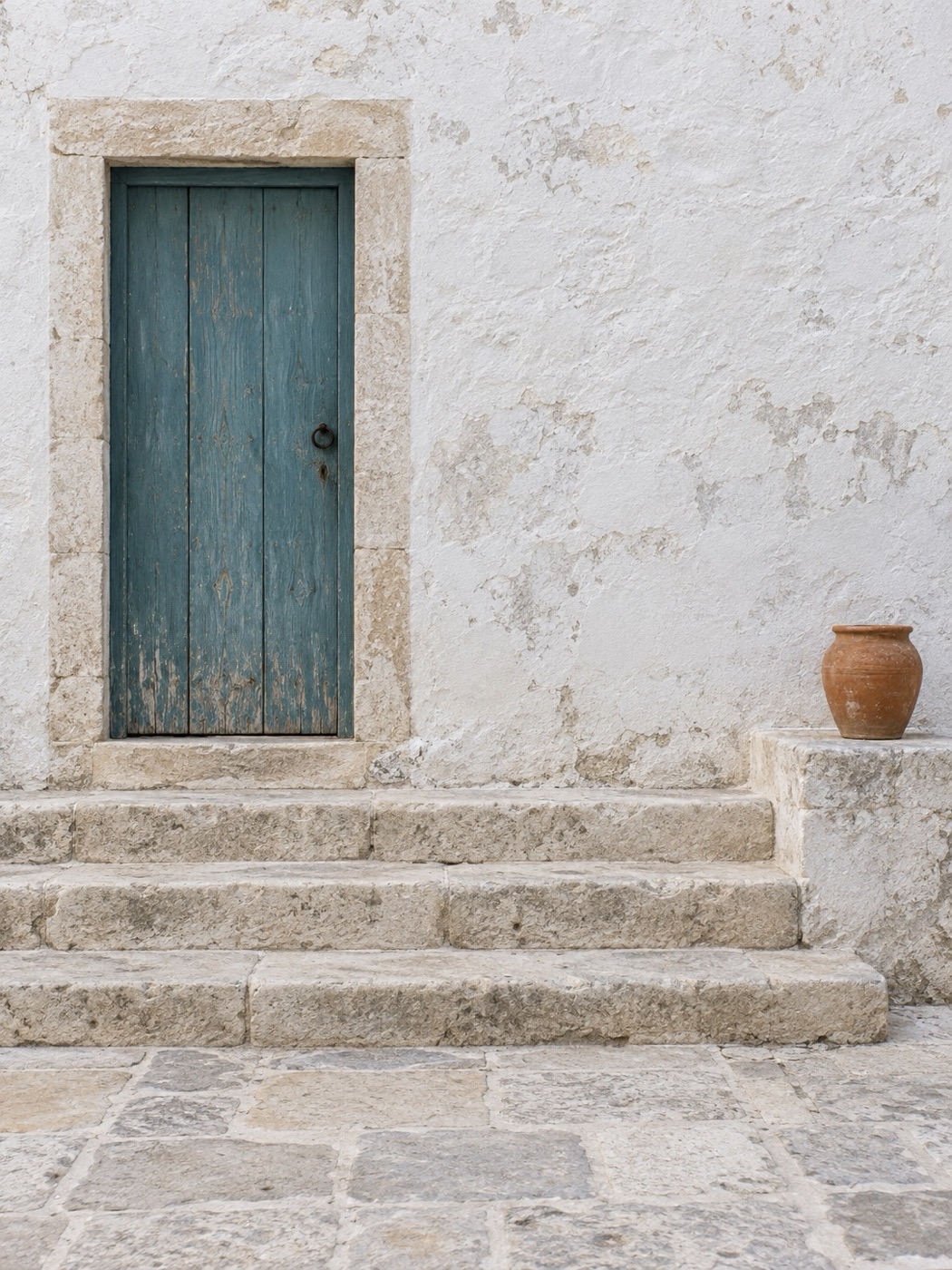 The place, before anyone arrives
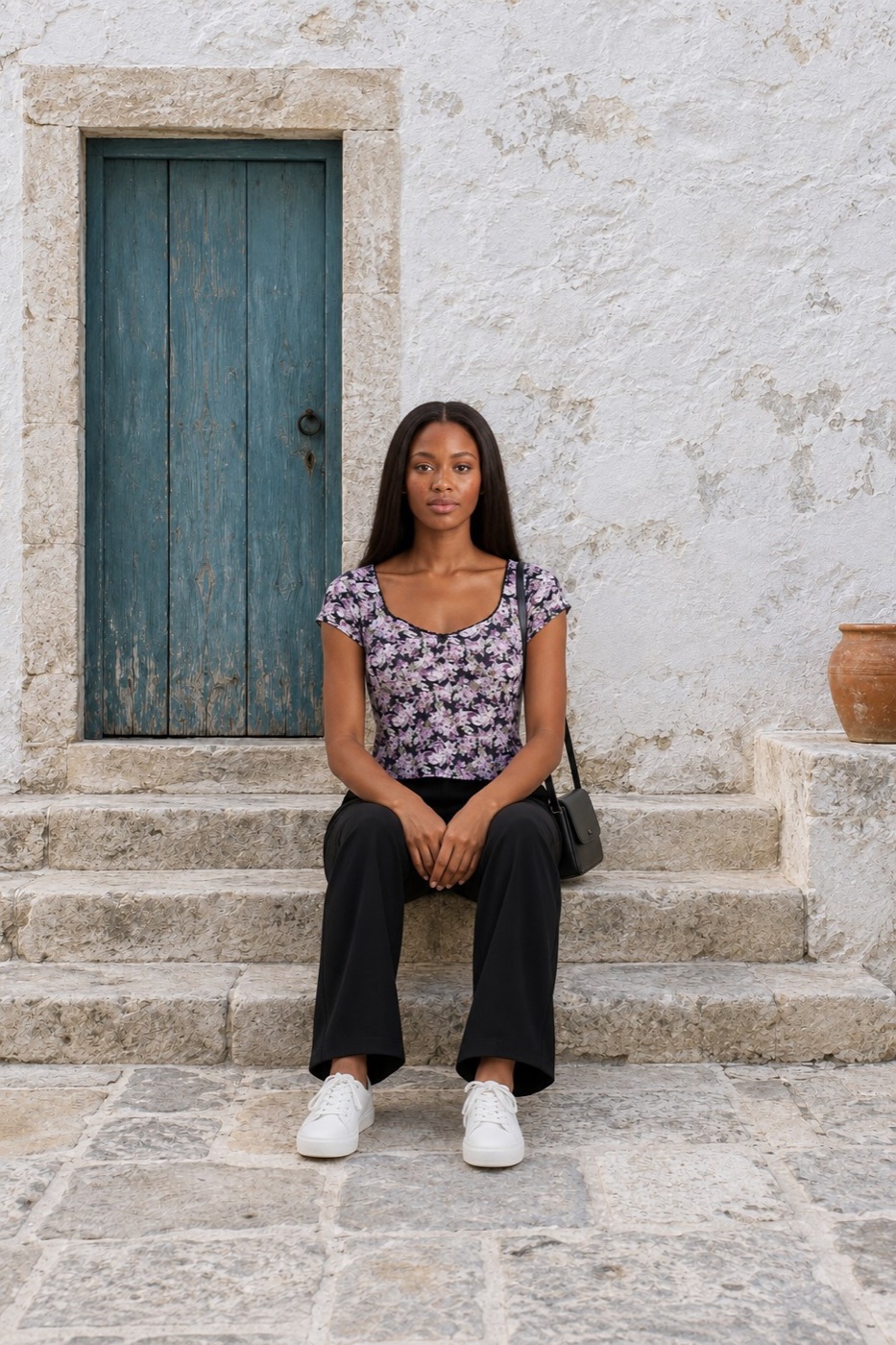 The same place, with her in it
The model has to touch something
Here's the thing about a real place: you don't stand in front of it. You use it. You sit on the step. You put your hand on the door to knock. You pick up the pot. That contact is what makes a location photo read as real, and it's exactly what most generated images avoid, because contact is hard. Hands have to close around objects. Weight has to land on stone. A body sitting on a step has to actually bend where the step is.
So we fine-tuned our models to interact with the environment rather than pose against it. Before a single frame is made, our models read the photograph the way a photographer walks a location before the shoot: what's actually here, what can a person do with it, where does the light come from, and where is the camera. Only then do they decide what happens in each frame. Sit here. Lift this. Knock on that. The actions come from the things that are genuinely in the picture, never from a stock list of lifestyle poses that would be just as true in any other place.
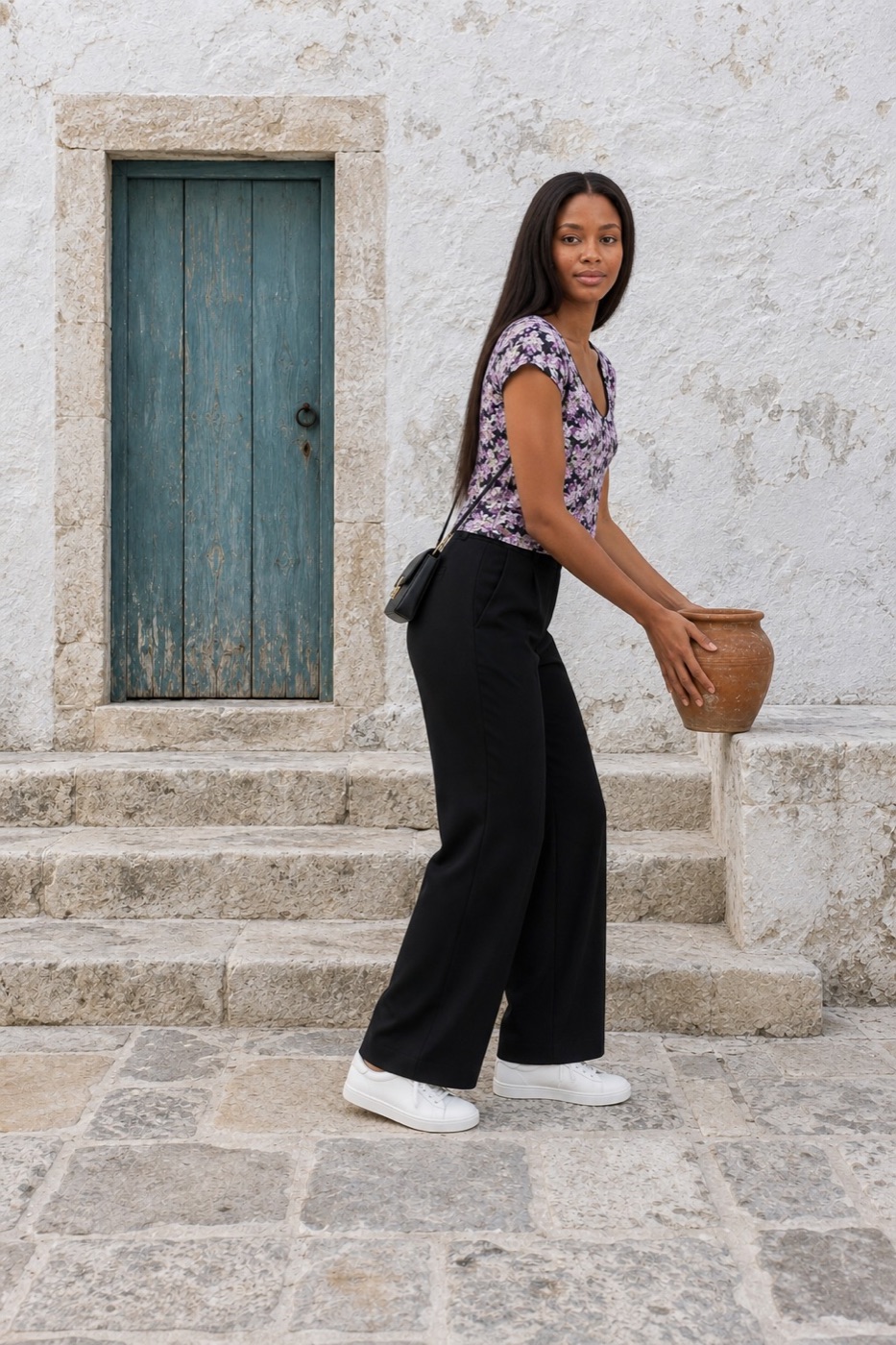
How big is a person here?
This one caught us out, and it's a good example of the kind of work that never shows up on a feature list. Early on, the location was faithful and the model was faithful and the photo was still wrong, because she was the wrong size for it. A doorway that should clear her head by a good margin came out at eye level. A pot that should take two hands to lift shrank to fit one.
A camera never has this problem. A person standing on real steps is the size they are. A generated image has to be told, and it turns out the useful way to tell it isn't in metres. Our models can't do numbers well; we wrote about that in the very first post on this blog. So we taught them to read a place in body terms: this ledge is hip height, these steps are shin-high, the top of that door is a head and shoulders above a standing person. Then we made a rule of it: the model is sized to the place, never the place to the model. A frame where the doorway comes out shorter than the person doesn't reach you. We'd rather take the shot again than ship a giant.
Same light, same camera, every frame
Two more things a real shoot gets for free and a generated one has to earn. The light in the photograph is the light in the lane: a soft, high, slightly warm daylight coming over the wall. Our models light the model with that light, from that direction, so her shadow falls where the pot's shadow falls. And the camera never wanders. It stays where the photographer stood, so when she sits, stands, or turns to the door, she's turning within a fixed view of a fixed place, not conjuring a new angle on a new one.
The practical upshot is that the five frames feel like a contact sheet from one afternoon, not five separate guesses about where you might have been. That's the difference between "a nice image" and "a shoot".
What it isn't
A Theme is not a filter and not a green screen. We don't cut your model out and drop her on a picture. And it's not a prompt box where you type "Italian street" and take your chances. The set is a curated, photographed place; the poses are drawn from what's really in it; and every frame is held to the photograph before it's allowed out. That's more constraint than most tools offer, on purpose. Constraint is what makes a place feel like a place.
It's also, honestly, a first version. There are places we don't have yet, and there are actions our models still get wrong often enough that we don't let them try. We'll add locations as we shoot them, and widen what the model is allowed to do in each one as it earns it. If there's a place your garments belong, tell us. We'd like to go there.
Why we built it this way
It would have been faster to build the poster version. Describe a scene, generate five variations, ship. Plenty of tools do exactly that, and the photos look like what they are. We took the longer road because the point of a lifestyle photo is trust: a buyer looks at a person in a place and believes, for a second, that the moment happened. The instant the feet float or the door shrinks, that belief is gone, and it takes the garment with it.
So the rule we built to is simple to say and hard to do. If a real model were really standing in that real place, this is the photo the camera would have taken. Everything else is a backdrop.
Themes are rolling out in the roopafy beta now, at the same price as a standard set. Pick a place. See what she does with it. Mason · Chief Architect, roopafy